 "Preceded by 1893 Ch d'Yquem (with foie gras) and followed by '26 Ch La Mission Haut-Brion, a rather bold, in fact essential divider. Served very cold. Light, malty, and opening up as it approached room temperature, revealing vanilla and a touch of honey; dry enough, firm, oaky Chardonnay flavour. It seemed to get sweeter on the nose and palate. Almost too sweet. At Christian Sveaas' great wine dinner in Oslo, April 1996.***" - MB
Showing posts with label burgundy. Show all posts
Showing posts with label burgundy. Show all posts
Friday, June 22, 2007
Broadbentism: 1992 Leflaive Bienvenues Batard Montrachet
"Preceded by 1893 Ch d'Yquem (with foie gras) and followed by '26 Ch La Mission Haut-Brion, a rather bold, in fact essential divider. Served very cold. Light, malty, and opening up as it approached room temperature, revealing vanilla and a touch of honey; dry enough, firm, oaky Chardonnay flavour. It seemed to get sweeter on the nose and palate. Almost too sweet. At Christian Sveaas' great wine dinner in Oslo, April 1996.***" - MB

Friday, April 20, 2007
Premature Oxidation in Burgundy Whites

Monday, November 27, 2006
Two Pinot Noir Hits for Special Occasions
 Pinot Noir is a finicky grape. It is thin-skinned, demanding and inconsistent. (I see you comparing it to some of the relatives you saw over Thanksgiving!) At its best, however, Pinot Noir can be hauntingly elegant and complex. The key to a good Pinot Noir is an even better producer, someone who can tame that persnickety berry into a multifaceted, memorable wine.
I had two Pinot Noirs from two such producers over the weekend. Although not inexpensive, they represent some of the best of what is inherent to Burgundian Pinots as well as California Pinots, showcasing the style and potential of each region.
The first was the 2002 Perrot-Minot Gevrey Chambertin. This is a village wine from the Gevrey Chambertin appellation in Burgundy, France and, as such, is a bit overpriced at $60. The excellent 2002 vintage is commanding high prices across the board and, given the bottle was for my wine-loving uncle and Perrot-Minot is known for quality wines in the classic Burgundian style, I decided to buy it anyway. I was not disappointed — and neither was my uncle or anyone else around the table for that matter.
The wine is elegant with seamless balance and a beautifully delicate floral fragrance. The palate is more powerful, as is typical with Gevrey Chambertin, and the wine has a very fine, silky mouthfeel. The characteristic cherry and earth flavors are there along with intricate layers of flavor and a long smooth finish. The refreshing but not overbearing acidity makes it a great match for food with which it was meant to be drunk. This is classic Burgundy in the traditional sense.
 2002 Perrot-Minot Gevrey Chambertin Report Card
Intensity: B+
Complexity: A
Balance & Structure: A
Current Grade: A
Peak Grade: A
The second Pinot Noir tasted this weekend was the 2003 Testarossa Pinot Noir Gary's Vineyard from California, also priced at $60. I had always been a fan of Gary’s Vineyard (which is located in the coastal Santa Lucia Highlands area of California) although I had not tasted the Pinot in years. I remembered it fondly as a good California Pinot Noir — more obvious fruit and body than Burgundy Pinots but not overly sweet or heavy like some Cali Pinots. True to form, the 2003 is made in a subdued and silky style but with the ripe fruit you expect from sunny California. The aroma is intensely cherry and the palate plush and sweet, balanced by a fresh acidity. You can sense a bit of the oak on the palate but it is well rounded and serves to give the wine a nice toasty character. The wine is well balanced and a nice match for a wide range of foods. This is a great pick if you enjoy Red Burgundy but want to try something from the U.S. —something that does not stray too far from the French style.
 2003 Testarossa Pinot Noir Gary's Vineyard Report Card
Intensity: A
Complexity: B+
Balance & Structure: A
Current Grade: A
Peak Grade: A
Vino Girl says cheers to being finicky!
Saturday, November 04, 2006
Barrels of Fun
 Winemonkey and I attended a Christie's tasting of recent
Hospices de Beaune Background
The Hospices de Beaune was founded in
The wine auction, which takes place on November 19th and 20th and is part of an annual festival in
Visions of White
We discovered some inspiring whites at the tasting, though. Our two favorites were the 2000 Batard-Montrachet-Cuvee Dames de Flanders (rich and intense) and the 2004 Meursault-Charmes Cuvee Albert Grivault (beautifully perfumed nose, nice minerality.) Having been impressed with 2004 White Burgs from the start, and particularly enjoying the Meursault at the tasting, we purchased a 2004 Girardin Meursault Les Charmes-Dessus at Morrell afterwards. Vincent Girardin is a consistently good producers and this is a lovely bottle of wine with good weight, nice minerality, and an abundance of citrus and tropical fruits.
Buy a Barrel
If you love
Thursday, October 05, 2006
2004 Burgundy
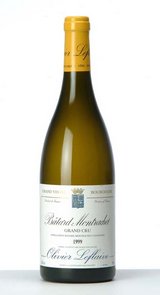 How is it that so many new world chardonnays are over the top and yet so many white Burgundies are sublime? Is it the harmony of apple, pear, lemon, spice, hazelnut and vanilla? Is it terroir? Its probably a little bit of both. I have always found the style of white burgundy to be more inline with my personal palate than some showier Cali Chards which to me alwas showed a little too soft and a little to oaky. (Now this was not always the case, we tasted a mid 80s Rombauer Chard the was excellent while their stuff today is too oaked for my palate. )
Recently, I had the chance to taste through many 2004 white burgs and while I am not an expert in this field to the extent of a burghound it is a personal fascination of mine and a white I am inclined to drink. So, since our publication focuses on a very different area of wine, I am more than happy to write about my white burgundy experiences here.
The 2004s are shaping up to be a very fine vintage indeed. Very nice, classically structured and flavored wines across the board. I was sorely disappointed in the 2003s and have avoided them on more than one occasion. And now that it is bookended by both the amazing 2002 and the fine 2004, it looks like 2003 is destined to be a favorite of the cherrypickers. I am sure there will be some outstanding values in 2003 and if I find any I'll let you know.
Now, while your winemonkey certainly likes his Batard-Montrachet, they come few and far between so what I am talking about here is the likeability of so many of the "lesser" and outlying areas.
For example, Olivier Leflaive's wines were outstanding from top to bottom. Now the top is expected to be outstanding. Enough said. But, I have found that the wines toward the value end of the Leflaive portfolio gets lost in the shuffle and are just a tad too simple. In 2004, however, I feel like that is not the case. The basic stuff is a just a notch up and I feel like I am getting a really nice bottle for the price.
Now if you don't expect Montrachet in a bottle of St. Veran I think you will do well so drink up.
-------------
Some of my favorite producers/wines in no particular order (some pricey, some not):
Olivier Leflaive- great across the aboard, good consistency
Domaine Ramonet- come on, its Ramonet
Bonneau de Martray- when I think Corton Charlemagne, I think BdM.
Raveneau- Some of the best values in white burgs are Grand Cru Chablis
Sunday, September 24, 2006
A Toast to a Great Burgundian
 I realize I am a claret monkey, but a glass must be raised nonetheless...
Famed Burgundy winemaker Henri Jayer died this past Friday at age 84 as reported in the NY Times. There is a little I can say that hasn't already been said in the article or on Mr. Parker's bulliten board.
So, here's a shout out to all the untrained vineyard workers (and wine writers) with a dream! Sotheby's has Jayer's 1978 Vosne-Romanée 1er Cru Cros Parentoux (the wine that put him on the map) estimated at $5,000 per bottle with only 3,500 bottles made per vintage.
Buyer's take note: In this winemonkey's humble opinion, while the 1978 is historically significant and would grace any cellar, the smart money is going to be on the 1997 1er Cru Cros Parentoux Reserve. This was the first vintage of the "reserve."
When Henri turned over the operation to his nephew-in-law Emmanuel Rouget in 1996, he kept 1/3rd of Cros Parantoux for himself . In 1997 he bottled 1400 bottles of Henri Jayer Cros Parantoux Reserve and only did this from 1997 until 2001.
Gary Danko has a 2000 on the wine list for $2,200 and to give you all some perspective on how important Henri was, they have the 2000 Vosne-Romanée Grand Cru, Domaine de la Romanée-Conti La Tâche for a mere $1,000.
Drink up and dream!
Subscribe to:
Posts (Atom)